By La Formule FrançaisePublished 6 min read
Automated trading is a rule set that places orders without a person clicking. That is the whole definition. Everything sold on top of it — the intelligence, the certainty, the percentage — is an addition to the definition, not part of it.
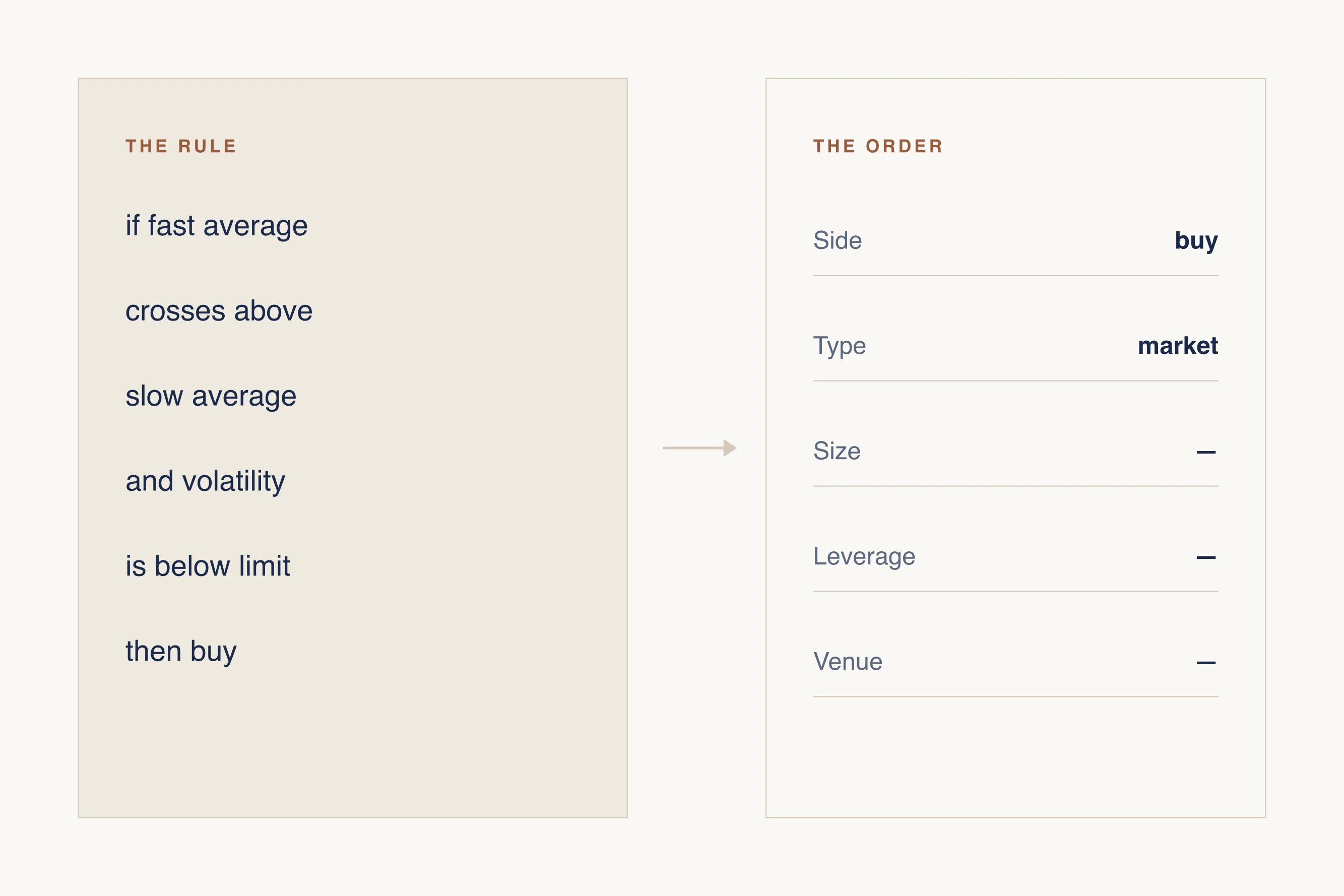
Automation changes who presses the button. It does not change whether the rule was worth following.
The definition, and what gets added to it
An automated trading system has three parts: a source of prices, a rule that turns those prices into a decision, and a connection to a venue that can act on the decision. Nothing in that description implies the rule is good. A system that buys every Tuesday and sells every Thursday is automated trading.
The marketing around the category attaches things the definition does not contain. "Algorithmic" means the rule is written down, not that it is sophisticated. "AI-driven" describes how the rule was arrived at, not how well it will work on prices that have not happened yet. "Automated" means no one is clicking, which is a statement about labour, not about profit.
What automation genuinely buys you
There are real advantages, and they are worth naming precisely, because the exaggerated version is built on top of them.
- Consistency. The rule is applied the same way at 3am as at 3pm, after a loss as after a win. Most discretionary traders fail to do this.
- Speed. Some strategies only exist because a machine can act within milliseconds. A human cannot participate in those at all.
- Capacity. One system can watch hundreds of instruments at once, which no person can.
- Measurability. A rule that is written down can be tested, argued with and disproved. A feeling cannot.
What it does not buy you
It does not produce a forecast. The rule contains someone's belief about how prices behave; automation applies that belief faithfully, including when the belief is wrong.
It does not remove risk. It changes the shape of the risk — from a person losing their nerve to a system doing exactly what it was told while conditions change underneath it.
And it does not remove costs. Every order pays the spread, most pay a commission, and a system that trades often pays both more frequently than a person would. That arithmetic is covered separately.
The two categories people confuse
It is worth separating execution from strategy, because the industry deliberately blurs them.
- Execution automation: you have already decided to buy; software decides how to split the order to get a better average price. This is mature, widely used and largely uncontroversial.
- Strategy automation: software decides whether to buy at all. This is where the claims are made, and where the evidence is hardest to produce.
Where to go from here
If you want the mechanism, the stage-by-stage page is next. If you have been shown a performance chart and want to know what it is worth, start with backtests instead.