By La Formule FrançaisePublished 7 min read
A strategy does not need to be wrong to lose money. It needs only to be less profitable than the sum of the frictions it pays, and those frictions are charged on every single trade whether it wins or not.
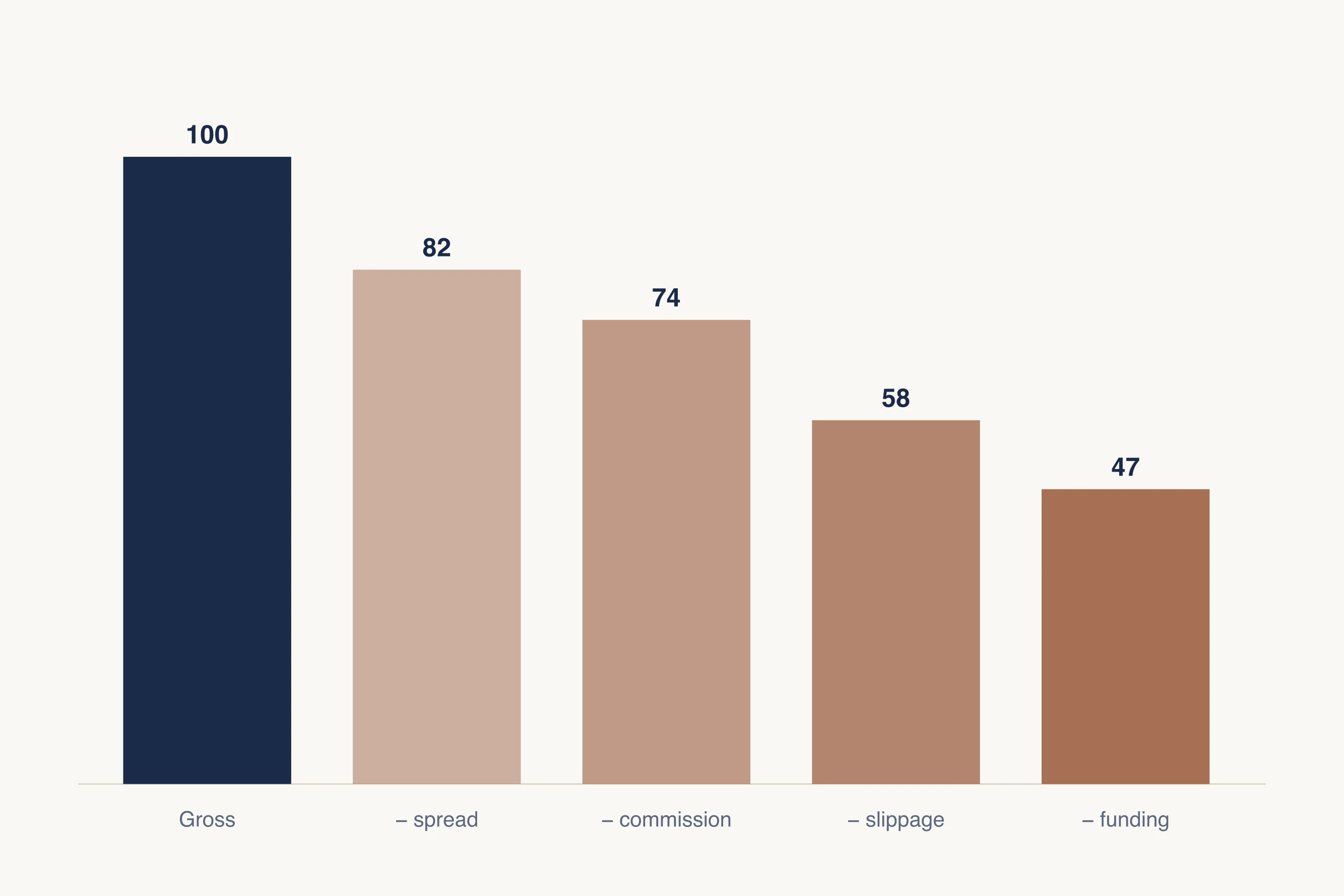
The more often a system trades, the more of its result is decided by costs rather than by the rule.
Spread
The gap between the best price to buy and the best price to sell. You cross it on the way in and again on the way out, so a round trip pays it twice before the position has done anything.
Spread is not constant. It is narrowest when nothing is happening and widest exactly when a volatility-triggered system wants to act, which means the historical average understates what an active strategy actually pays.
Commission
The venue's fee, usually a percentage of notional value and usually different for orders that add liquidity to the book and orders that remove it. The first is often cheaper and sometimes rebated; the second is what a market order pays.
This is the one cost most reliably included in a backtest, which is convenient, because it is rarely the largest.
Slippage
The difference between the price the signal saw and the price the order was filled at. It comes from the delay between decision and execution, and from an order being large enough to move through more than one level of the book.
Slippage is the cost most often set to zero in a test, and the one that most reliably grows with size. A strategy that works on a small account can stop working on a large one for no reason other than this.
Funding and financing
A leveraged or perpetual position is financed, and the financing is charged periodically for as long as the position is open. On perpetual futures the rate is set by the imbalance between long and short interest, so it is typically most expensive to hold the position that most people want to hold.
A system that holds positions for days accumulates this cost quietly. It does not appear at entry or exit, which is where most people look.
The costs outside the trade
These are left out of essentially every demonstration and are paid regardless of performance.
- Withdrawal and network fees, charged when money leaves.
- Currency conversion, if the account is denominated in something other than the money that funded it.
- Data and infrastructure, if the strategy needs a feed or a co-located server.
- Tax, which in most jurisdictions applies to realised gains whether or not the account ends the year up.
Why this matters most for frequent systems
Costs scale with the number of trades. The rule's edge scales with the quality of the rule. A system trading a few times a year can absorb a wide spread; a system trading many times a day is, in practical terms, competing against its own transaction costs first and the market second.
This is why high-frequency claims deserve the most scrutiny rather than the least: the frequency being advertised as an advantage is also the multiplier on every friction on this page.