By La Formule FrançaisePublished 9 min read
The automated-profit funnel is a genre with a fixed set of components. Once you can name the parts, the individual site stops mattering: you are reading a template, and the template has a purpose.
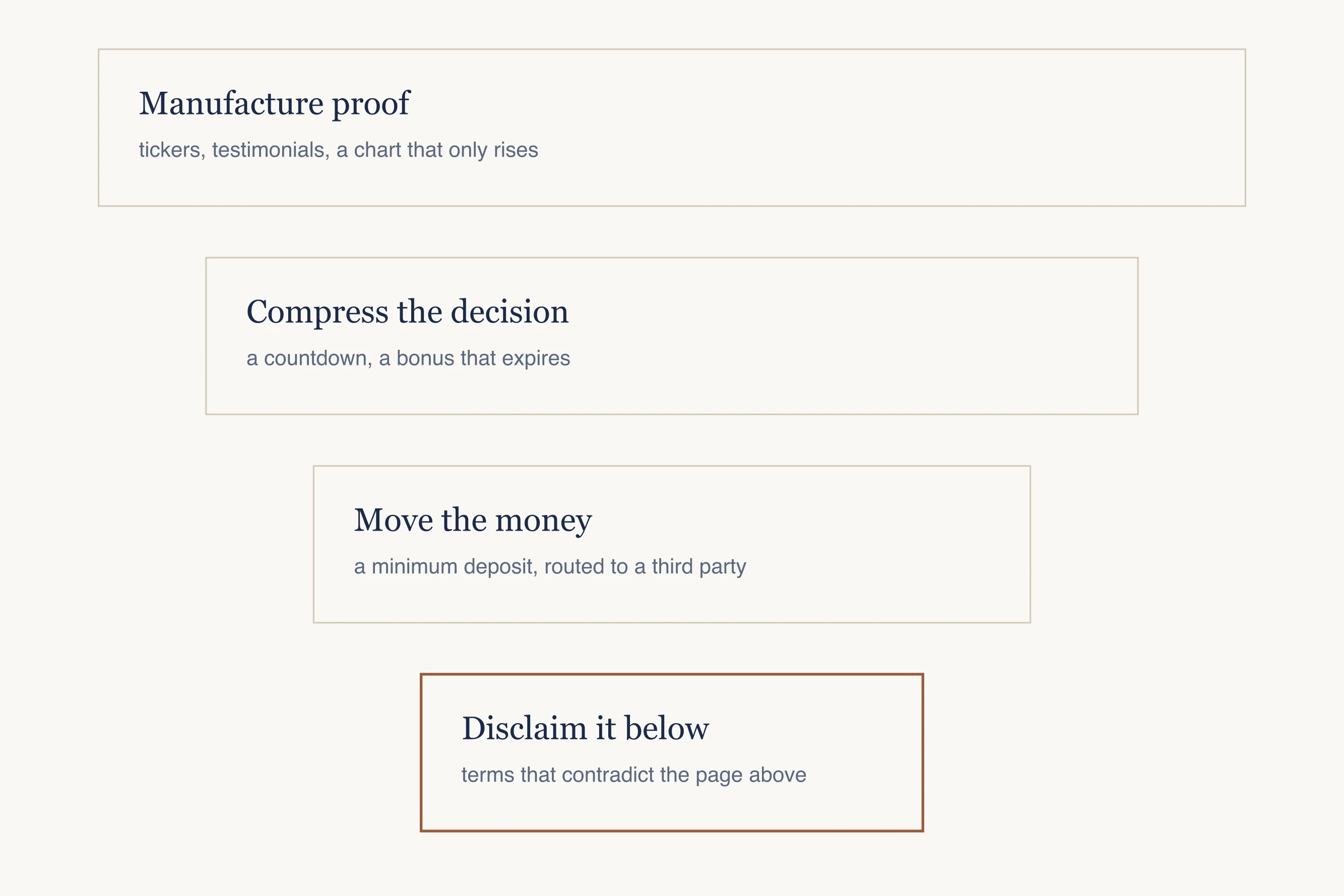
Every component below exists to shorten the interval between arriving and depositing. None of them is evidence of anything.
The live winner ticker
A strip of recent successes scrolling near the top: a first name, an initial, an amount, a timestamp. It creates the impression of a populated, active service.
It is generated by the page. The names, amounts and intervals are produced in the visitor's own browser, which means the same visitor reloading the page sees a different set of winners with equal confidence. Nothing is being reported; something is being rendered.
A countdown attached to a bonus
A deposit bonus that expires when a timer reaches zero. The timer resets on reload, which is the whole point: it is not measuring anything, it is removing the interval in which someone would search for reviews.
Anything genuinely worth doing with money is still worth doing in an hour. A deadline that exists only on the page is a statement about the seller's needs, not the buyer's opportunity.
Testimonials with profit figures
Named individuals, usually in recognisable Western cities, with specific amounts earned over a stated period. Sometimes photographs.
Two things make these unusable as evidence. They cannot be checked, by design — no verifiable identity, no account statement, no venue. And in most regulated jurisdictions, presenting past profit as an indication of future return is restricted precisely because it is so effective and so uninformative.
Claims that no strategy can make
Some sentences are self-refuting if you take them literally. These recur nearly verbatim across the genre.
- Profit in both rising and falling markets, stated as a guarantee rather than a possibility.
- A win rate quoted without the average size of a win and a loss, which together decide whether the win rate means anything.
- A specific amount earnable on the first day, which requires knowing tomorrow's prices.
- "Risk-free", applied to an activity where the money is committed to a market.
- Technical language that describes security rather than performance — encryption standards, server grades — placed where evidence of returns should be.
The deposit that is the actual product
The funnel almost never holds the money itself. It introduces a third-party broker and is paid for the introduction, typically at the moment the deposit clears and independently of whether the depositor ever profits.
This is why the minimum is always stated so precisely, and why the page is far more specific about how to deposit than about what happens afterwards. The deposit is the conversion event. Everything above it is there to produce it.
The disclaimer that contradicts the page
The terms page is usually the most accurate document on the site. It commonly states that the operator is a marketing and advertising service rather than a broker, that it provides no brokerage or investment services, and that a representative from a third party will be assigned on signup.
That is an accurate description of an affiliate lead-generation page. It sits three clicks below a headline promising automated profit, and the contradiction between the two is the clearest signal available.
What to do with a page that has these parts
Nothing on this site tells anyone what to do with their money. But the checks below are factual, free and take a few minutes.
- Reload the page and see whether the winners and the timer reset.
- Read the terms page before the landing page.
- Search the company name against your national regulator's register and its public warning list.
- Establish who holds the money and under what licence, before considering anything else.
- Treat the absence of a maximum drawdown figure as information in itself.